
AI Strategy and Transformation
Business Strategy
What Does Value Creation Mean in 2026? Takeaways from the IPEM Value Creation Summit
September 14 2026


For the second year running, Singulier x OMMAX co-organised and co-sponsored the Value Creation Summit at IPEM Global Paris 2026.
Leading GPs, operating partners, LPs and technology leaders addressed a question that has grown sharper each year: in a market where cheap leverage has gone and multiple expansion is constrained, where does value creation come from? The answer was consistent: operating depth, AI embedded in the business model, and the discipline to do fewer things better.
Value creation is an operating system now
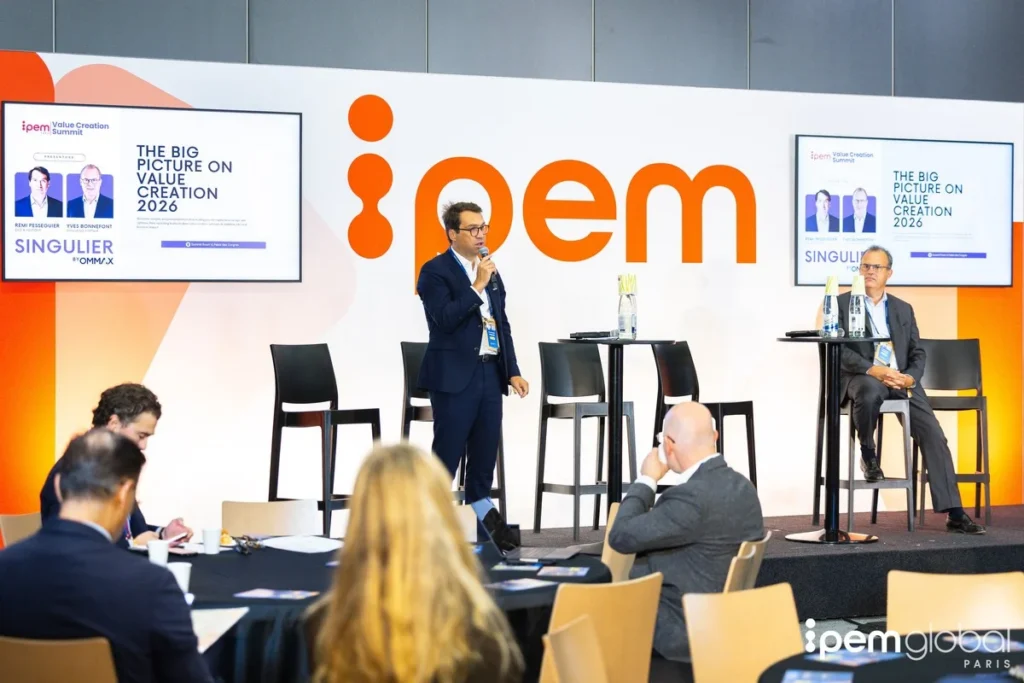
Rémi Pesseguier and Yves Bonnefont opened with Singulier’s latest Operating Partner Benchmark across thirty key European buyout funds. Teams have grown from 416 to 507 FTEs over two years, though the pace has halved. Specialists now account for 62% of the average team, with ESG and Data & AI leading recent hiring. Digital and technology hiring remained limited. Coverage is the constraint, not headcount — one operating FTE per €1bn of enterprise value cannot lift a portfolio one project at a time. The funds generating consistent returns are codifying what works and repeating it across the portfolio. “Value creation in 2026 is an operating system, not a list of initiatives.”
Round two: AI shifts from pilots to obligation
Moderated by Toni Stork, Group CEO of OMMAX, “The AI-Powered Portfolio” brought together operating partners from leading buyout funds and enterprise software leaders. One panelist, a boxer in his personal pursuits, offered an immediate framing: “We’re at the end of round one.” Portfolio companies spent the past twelve months launching genuine pilots with real capital, testing what AI could actually do to extract value. PE firms built connective tissue with LLM developers and enterprise software vendors. The lessons from round one are clear.
The market is now firmly in the adoption phase. CXOs broadly accept that companies which fall behind on AI adoption will not produce the same returns as their peers. The conversation has shifted from “should we?” to “how do we do this right, inside the holding period?”
A data point from the OMMAX x Singulier AI Trends Report with Statista added important context: 40% of organisations cite system and data foundations as their top barrier to stronger AI impact. Only 7% place AI ownership directly in business units. The challenge in 2026 is not ambition. It is foundations and accountability.
The diligence model has been rewritten
The most sophisticated funds now conduct an AI risk and opportunity assessment on every deal they evaluate, with depth calibrated to the target’s digital exposure. The framework covers four dimensions: the industry ceiling, meaning the maximum AI value achievable in that sector; the company’s current capabilities, including talent, strategic vision, data infrastructure and process automation; the gap between the company and the industry; and competitive disruption risk. A banking target faces fundamentally different AI pressure from an agricultural business, and the assessment reflects that.
The panel’s view on what a senior partner on an investment committee should always press on came down to three points: whether AI will harm, improve or have no material effect on each business unit; what will constitute table stakes versus durable competitive differentiation across a five-to-ten-year hold; and whether the company holds proprietary data or models that competitors cannot replicate.
On LLMs, the advice was unambiguous: avoid vendor lock-in at all costs. That applies to partner selection, architecture and solution design. A model’s proprietary memory or storage features can create a dependency that is expensive to unwind. One model leads today; a different one may lead tomorrow. Different models are better at different tasks. Flexibility must be designed in from the start.
Governance, people, organisation
Post-close, the three priorities for AI transformation were governance, people and organisation. “Get these right and the rest is hard but achievable. Get them wrong and no technology package will compensate.” The people question is specific. Seek leaders with experience driving technology-led transformation generally, since the AI-specific track record is simply too new to require. Look for people with a builder mentality, comfortable with positive destruction and reconstruction under EBITDA and leverage constraints.
The parallel drawn was to ERP implementations: no responsible software partner will recommend full AI modernisation in a company unless all CXOs are aligned. If even one is opposed, the probability of success falls dramatically. The use-case selection principle is equally clear: concentrate on one or two use cases tied directly to the commercial engine of the business. The “let a thousand flowers bloom” approach does not work.
The strategic choice underpinning all of this is whether AI is used to do things better, meaning incremental efficiency gains of 10–50% on existing processes, or to do better things: new products, new customer experiences and new revenue models. The former is lower risk and carries lower multiple impact. The latter commands higher multiples but requires deeper transformation. Start with the desired customer experience or internal process outcome. Define monetisation. Only then decide what technology is needed. Reverse that order and the result is a model that works but generates no EBITDA.
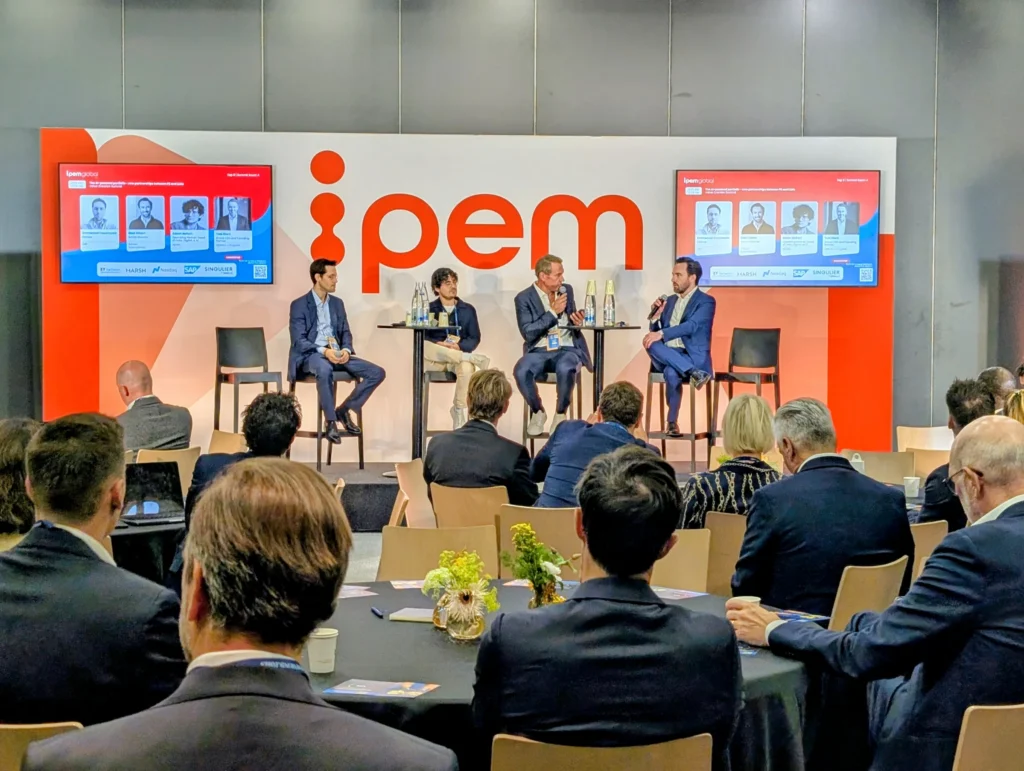
Toni Stork, Group CEO of OMMAX and Singulier, moderating “The AI-Powered Portfolio” panel with Emmanuel Cassimatis of SAP, Gaël Gibert of Advent International and Adam Nahari of Apollo Global Management at the IPEM Value Creation Summit 2026.
Operating partners move to the centre, not the chair
“The best board meeting I have is the one where I say nothing, where management is fully prepared and the conversation is exactly the one it needs to be.” Value creation teams have grown significantly, from three people twelve years ago to nearly 25 at one fund today, and are now present from origination through to exit. But the governance philosophy is shifting in a clear direction: sparring partner, not seat-holder. The real work happens before the board convenes.
One counter-intuitive observation on internal versus external resources: the more internal capability a fund builds in a given domain, the more external resources it also deploys in that domain. The two are complementary, not substitutes. Internal staff are essential for identifying needs, qualifying vendors and supervising delivery. Without an internal anchor, an external-only model is unworkable in practice.
Buy and Build: scale matters, discipline is survival
Building value from integration was also discussed in the summit, with some great case studies. In the case of two European businesses merged for expansion, the investors put a two-year integration plan in place. It ultimately took five years, due to a cultural clash at the most senior management level. “You can do all the planning, all the interviews, all the consultants you want. Until you start implementing the 100-day plan, you will not know.” The transaction still delivered a 5x return for LPs, showing that integration delays do not destroy value when the underlying strategy holds.
Across 160 acquisitions, one panelist described recruiting 50 C-level hires including, but not limited to, managing directors, CFOs, M&A directors and digital transformation leads. The aim was not to add up companies but to build something designed to last. Scale, for traditional businesses in fragmented European markets, is not optional. It delivers diversification, pricing power, purchasing optimisation and talent attraction. But rising financing costs mean discipline is non-negotiable. When one CEO recently surfaced an attractive acquisition opportunity after the company had already tripled in size in under two years, the answer was no. Knowing when to pause is as important as knowing when to move.
Commercial excellence goes data-native
The commercial excellence panel reinforced a theme running across the whole day. Tools are not the constraint. One panelist noted that roughly a third of portfolio companies have never conducted proper pricing research, despite having the data available. The AI applications delivering results in portfolio company sales functions are lead generation, client data enrichment, dynamic pricing and forecasting. Two practical principles stood out: data hygiene must come first, since the data does not need to be exhaustive, only correct; and simplicity beats complexity. Providing sales teams with access to ChatGPT or Claude for standard tasks — responding to RFPs, scraping competitor websites, enriching databases and defining customer clusters — may be entirely sufficient before introducing more sophisticated tooling.
Operating teams with data and AI fluency will work faster, customised solutions will become more replicable across portfolio companies, and falling tool costs will steadily narrow the buy-versus-build dilemma that currently puts sophisticated software beyond the reach of smaller companies.
The talent paradox: builders who do not need the credit
Across every panel, the same gap surfaced. Technical skills can be found. What is genuinely hard to hire is the combination of technical competence, high emotional intelligence and a low-ego orientation, all in the same person. As one panelist put it: “Finding those three things at the same time is the most difficult challenge.”
For AI talent specifically, the profile is getting younger. The people coming through are technically strong but less tested in complex operating environments. A three-tier model is emerging at some funds: very senior IT resources internally; natively AI-fluent junior hires who are growing with the technology; and external specialists for the rest.
LPs are taking note. Large investors are now building their own domain expert teams in ESG, AI, cyber and procurement, and engaging at the specialist-to-specialist level rather than top-to-top. With tools like Claude and ChatGPT, LP scrutiny is intensifying. Investors are cross-referencing stated commitments against demonstrated outcomes in ways that were not possible two years ago. The effect on LP diligence over the next six to twelve months will be significant.
What this means in practice
The IPEM Value Creation Summit 2026 confirmed that value creation has moved from aspiration to infrastructure. The funds generating consistent returns are not doing more. They are doing the same things more systematically — with cleaner data, tighter use-case selection, AI integrated into the business model rather than appended to it, and leadership capable of building without needing to own the result.
Singulier x OMMAX brings these capabilities together. Singulier contributes expertise in strategy, data, digital and AI advisory, while OMMAX brings transformation capabilities. Together, we help private equity funds and portfolio companies turn ambition into measurable impact, from due diligence through to exit. Our teams implement alongside management, not in place of them.
Let’s Talk
If you are strengthening your value-creation capabilities, whether in AI readiness, commercial excellence, operating model design or data foundations, we would welcome the conversation. Get in touch with our experts today.

