AI Strategy and Transformation
The AI adoption curve: five moves to accelerate AI in the workplace
May 15 2026


More than 80% of the AI adoption gap between Europe and the US is explained by management practices and employer enablement rather than access to technology.
For private equity investors and portfolio leaders, this means AI adoption in portfolios is a people and operating model challenge before it is a tooling one. Most PortCo AI roadmaps also fail for a simpler reason: they target the most visible functions first, not the ones where AI can quietly remove hours of repetitive work every week.
In one recent transformation programme for a leading financial services business, the work did not begin with a broad tool rollout. It began by clarifying where teams were losing time, which workflows were ready for change and how new ways of working could be embedded in day-to-day operations. Only then did Singulier translate that into a live AI pilot and redesigned performance dashboards, a useful reminder that adoption depends as much on structure, habits and organisational buy-in as it does on the technology itself.
Where AI sits on the adoption curve
Every technology that reshapes how businesses operate tends to follow a familiar pattern. First comes invention, then a long period of obscurity. A breakout product drags the technology into the mainstream, followed by a noisy phase where tools multiply faster than use cases are understood. Over time, a standard emerges, consolidation happens,and the technology quietly becomes infrastructure.
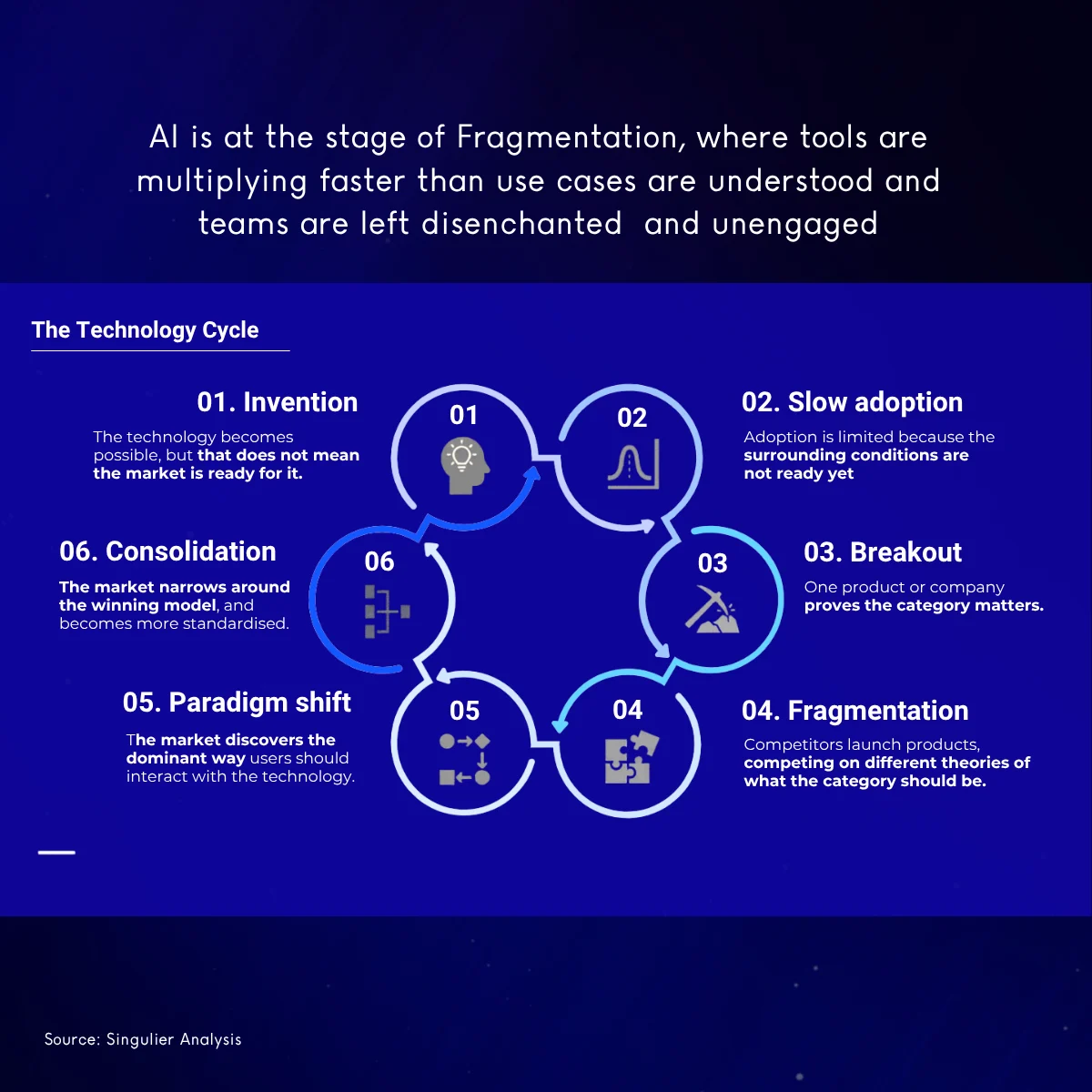
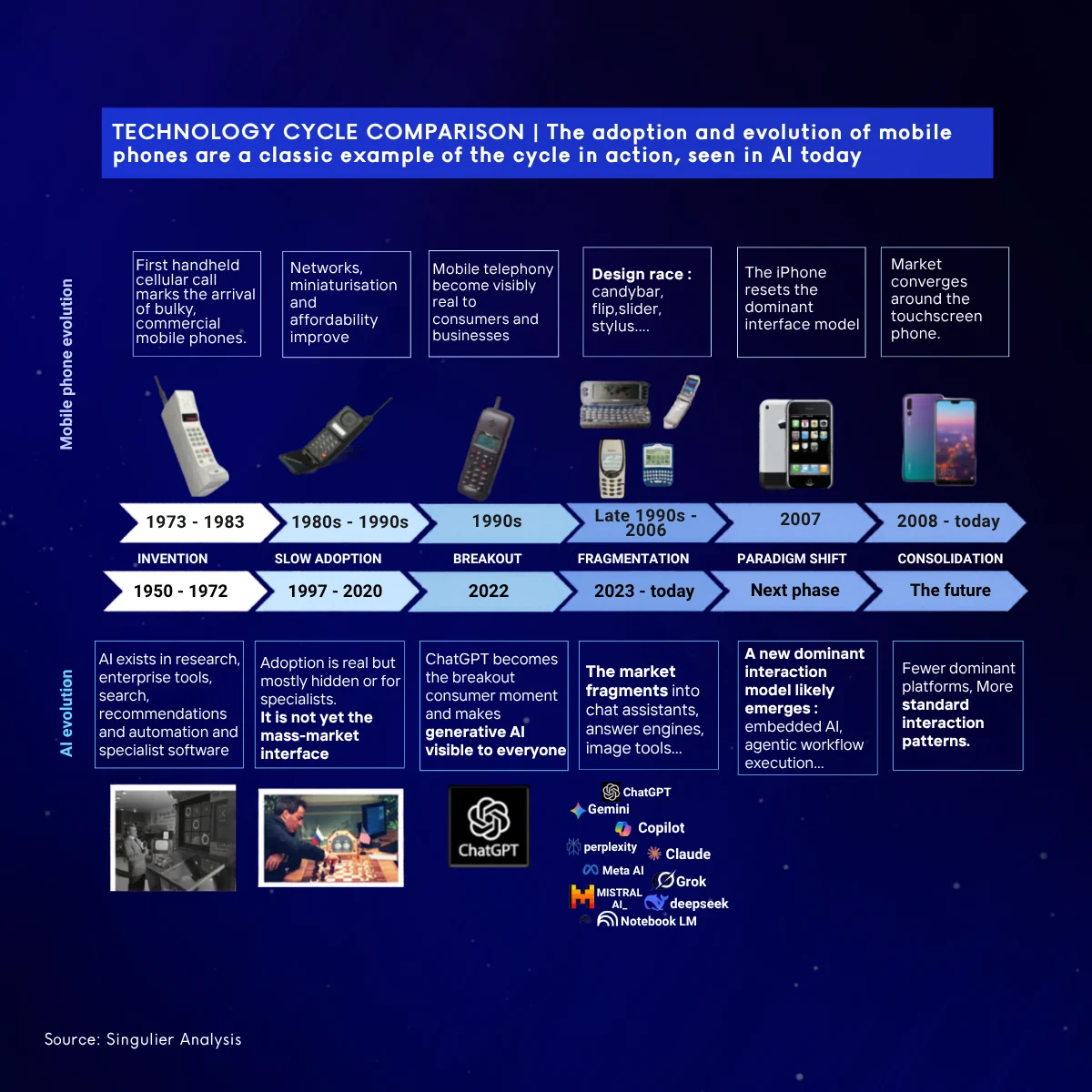
AI is on the same curve, only moving faster, the conceptual roots go back to 1950, but the real breakout moment was the launch of ChatGPT in November 2022, which shifted AI from specialist topic to general-purpose workplace tool within months.
Since then, we have entered the fragmentation phase: multiple large language model platforms compete for attention, rankings change week to week, and tools that led six months ago already feel outdated.
Both leaders and employees now face what early smartphone users faced: too many options, no clear standard, and reasonable anxiety about committing to the wrong one.
Failed adoption is not solely based on technology. They are framing and enablement shortcomings.
Without a shared narrative of where the organisation sits on the curve:
- some people assume they are “using it wrong” and quietly stop
- others decide AI is overhyped and become vocal sceptics
- leadership struggles to connect experiments to value-creation plans
Portfolios that still manage to ramp up adoption guide people through this curve on purpose, with clear choices and concrete changes in how work is done.
Five moves that shift workplace AI adoption
From our work in AI transformation projects, five moves enable stronger and more effective workplace adoption.
1. Start with a readiness diagnostic and use-case prioritisation
Many AI programmes start with a tool and a demo, not with a view of where the business
is actually ready to use AI and where it will help most.
The first move is to check where the business is ready to use AI, where the constraints sit across data, workflows, governance and teams, and which use cases are worth prioritising. This avoids scattered experimentation and gives leadership a clear basis for action and success tracking.
For portfolio companies, this matters because not every function is ready, and not every use case creates value quickly. Roadmaps that chase “headline” use cases often underdeliver. The ones that work focus on a short list of high value opportunities, test them early, and build the roadmap from what works.
This is where AI adoption becomes commercial, not just performative.
Singulier’s own work in AI transformation starts by assessing AI readiness, identifying high-impact use cases, and building a roadmap that is aligned to business priorities, operational feasibility, and long-term scalability.
2. Set clear expectations and normalise iteration
Every technology worth adopting has been through the fragmentation stage, and the organisations that pull ahead are not those that wait for a clear winner to emerge, but those that commit to a direction while normalising iteration.
That means two things in practice:
First, give management a shared narrative: tools and outputs will change, and the goal is to build confidence and momentum faster than competitors
Second, track progress instead of chasing perfection. A 70% output that saves a senior person 40 minutes is already a win. Celebrate initiatives that move work forward and where AI removes low-value, repetitive tasks, instead of expecting AI to perfectly deliver a series of complex tasks.
AI is moving too quickly for any output to be “final”. The role of an AI roadmap is not to guess where AI will end up, but to keep the organisation moving and adjusting as it evolves.
3. Invest in behaviours, not just tools
The platforms your teams use today may not be the ones they use in two years. The skills that last are how to frame a task, write a clear prompt, and review what comes back.
Training should therefore focus as much on how people brief and review AI systems as on which button to click. A small, shared set of prompt patterns for common tasks, used consistently across functions, is usually more powerful than a long AI manual no one reads.
This is consistent with what we see internally and with clients. Sustainable AI adoption depends on people knowing how to use AI in their real work with enough confidence and consistency to make it worth the effort.
4. Build shared knowledge infrastructure
AI knowledge should not sit only in individual heads or in one team. For PE investors with several portfolio companies, this is one of the biggest levers.
Portfolios that scale AI well tend to build:
- a curated library of use cases that work across industries/sectors
- named AI owners in key functions such as Finance, Operations and Commercial
- Simple and iterative guidelines that stay with the organisation
This moves organisations away from one-off experiments towards shared patterns that can travel across teams, it also makes it easier to update tools later without losing what has already been learned.
5. Create a culture that safely and actively enables continued AI use
Sustainable AI adoption is as much a culture question as a technology one.
The portfolio companies that move fastest share a few traits: people feel safe using AI on real work, teams are expected to continuously refine prompts and workflows, AI use is encouraged with clearly communicated guidelines, and leaders use AI in the open, showing that it is for everyone in the organisation.
Culture change usually lags behind tools. The best leaders do more than push for adoption targets: they sponsor the work, model the behaviour they want to see, and protect time for teams to learn and improve.
From experimentation to operational outcomes
Just as every major technology lands on a more stable state of adaption, AI consolidation will inevitably arrive. The question is not whether AI will matter to your portfolio, but how quickly your companies turn ambition into measurable operational impact.
What you build now, from a clear AI roadmap to an empowered AI culture, will decide whether your organisations arrive at the productivity plateau ahead of competitors or behind them.
Singulier works with private equity firms and portfolio companies to:
- Assess AI readiness across portfolios and individual businesses
- Design AI Strategy & Transformation roadmaps aligned with value-creation plans and deal theses
- Test and embed AI into concrete workflows, with clear ownership and EBITDA-linked metrics
- Build AI-Driven Business Optimisation programmes that turn scattered experiments into sustained value creation
If you are managing AI adoption across a business or portfolio and want a clear view of where you are on the curve and what needs to happen next, our AI Strategy & Transformation and AI-Driven Business Optimisation practices are built for exactly this challenge.
Let’s Talk
Speak to our experts to explore how we can support your portfolio’s next step on the AI adoption curve.

About Frederic Rougemont
Expert Partner and CPTO
Frédéric is an Expert Partner and CPTO at Singulier, leading our team of Product & Tech experts. A former CPO at Carrefour and Jumia, he specialises in e-commerce, supply chain, and logistics, advising investors and businesses on IT, AI-powered automation, and digital transformation.

About Adrian James-Morse
Director
Adrian James-Morse is IT & AI Architect and Director Technology at Singulier, leading the firm’s internal tech stack and AI architecture and designing secure, scalable, AI-enabled systems to support go-to-market and due diligence work.